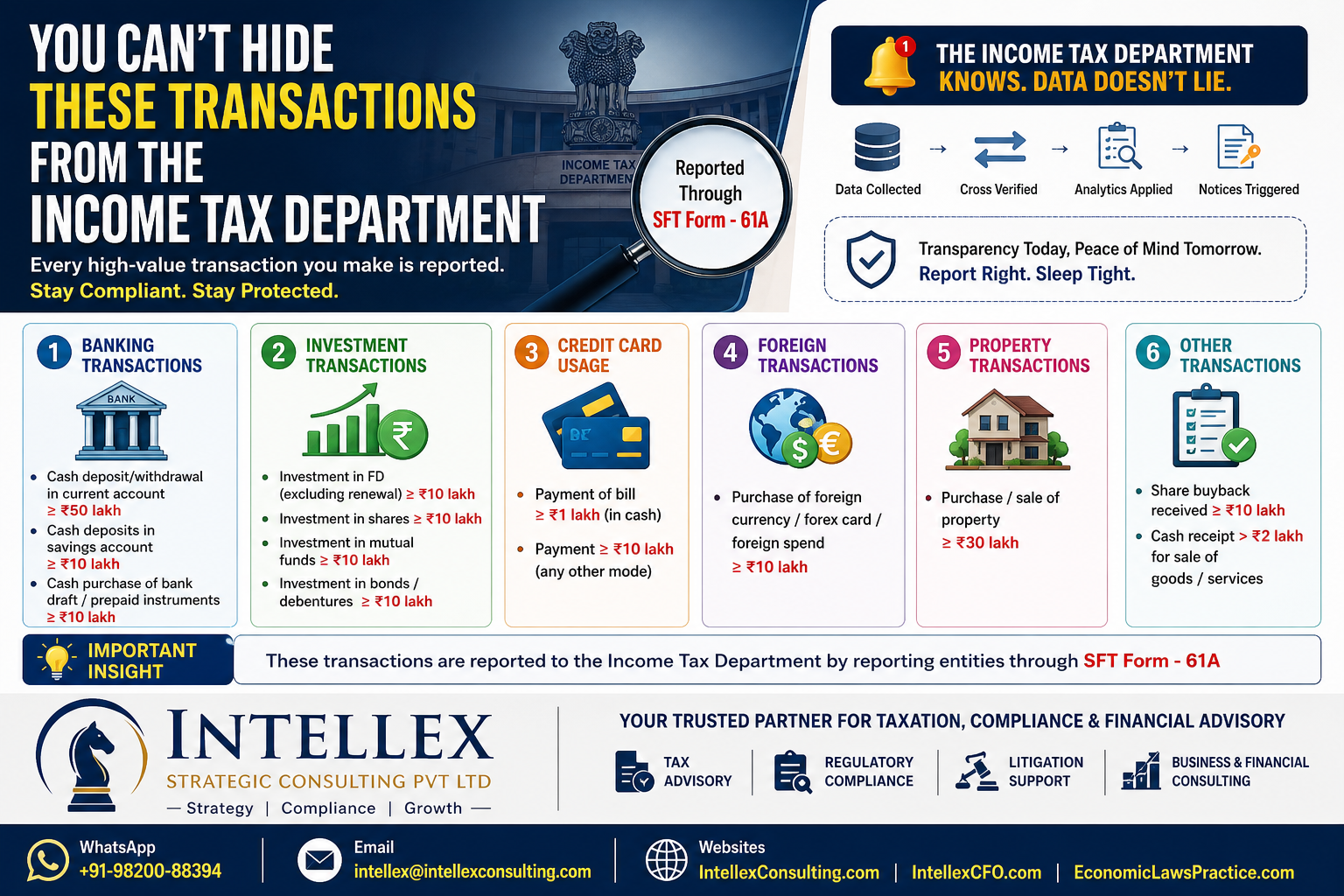
You Can’t Hide These Transactions from the Income Tax Department (FY 2026-27): A Complete Guide to SFT Reporting & High-Value Financial Surveillance.
Understand the high-value transactions reported to the Income Tax Department through SFT (Form 61A). Learn thresholds, compliance tips, and how to avoid tax notices in FY 2026–27.
In today’s increasingly digitised financial ecosystem, the Income Tax Department of India has access to a vast network of financial data. Many taxpayers still assume that certain high-value transactions go unnoticed. That assumption is no longer valid.
Through mechanisms like the Statement of Financial Transactions (SFT) filed in Form 61A, banks, financial institutions, registrars, and other reporting entities are legally obligated to report specified transactions. These are then cross-verified with your Income Tax Returns (ITR), PAN, and other financial disclosures.
If discrepancies arise, it may trigger scrutiny, notices, or even penalties.
This guide explains the transactions you simply cannot hide, along with practical insights to ensure compliance and avoid unnecessary tax complications.
What is SFT (Statement of Financial Transactions)?
Under Section 285BA of the Income-tax Act, certain entities must report high-value financial transactions to the government via Form 61A.
These reports feed into systems like the Annual Information Statement (AIS) and Tax Information Statement (TIS), giving the tax authorities a 360-degree financial view of taxpayers.
1. Banking Transactions That Are Closely Monitored
Banks are among the most active reporting entities. The following thresholds are critical:
- Cash deposits or withdrawals in current account ≥ ₹50 lakh (annual aggregate)
- Cash deposits in savings account ≥ ₹10 lakh
- Cash purchase of bank drafts, pay orders, or prepaid instruments ≥ ₹10 lakh
Insight:
Frequent cash dealings, even if legitimate, can attract scrutiny if not backed by proper documentation and declared income.
2. Investment Transactions Under Watch
Financial institutions and registrars report large investments across asset classes:
- Fixed Deposits (FDs) ≥ ₹10 lakh (excluding renewals)
- Shares (equity investments) ≥ ₹10 lakh
- Mutual Funds ≥ ₹10 lakh
- Bonds or Debentures ≥ ₹10 lakh
Insight:
Mismatch between investment levels and reported income is one of the most common triggers for notices.
3. Credit Card Usage Reporting
Credit card companies also report high-value payments:
- Cash payments towards credit card bills ≥ ₹1 lakh
- Total payments ≥ ₹10 lakh (via any mode)
Insight:
Large credit card spends without corresponding income disclosure can raise red flags, especially in lifestyle audits.
4. Foreign Transactions & Forex Monitoring
Global financial transactions are heavily tracked:
- Purchase of foreign currency, forex cards, or foreign spending ≥ ₹10 lakh
These may also be captured under LRS (Liberalised Remittance Scheme) reporting.
Insight:
Foreign travel, education payments, or overseas investments must align with your declared income sources.
5. Property Transactions: A Major Focus Area
Real estate remains one of the most scrutinised sectors:
- Purchase or sale of immovable property ≥ ₹30 lakh
These are reported by registrars and sub-registrars.
Insight:
Undervaluation, cash components, or stamp duty discrepancies can lead to deeper investigation.
6. Other High-Value Transactions You Should Know
- Share buyback proceeds ≥ ₹10 lakh
- Cash receipts exceeding ₹2 lakh for sale of goods or services (Section 269ST implications)
Insight:
Cash transactions above prescribed limits are not only reportable but may also attract penalties.
How the Government Tracks You
Modern analytics tools and data integration platforms enable the Central Board of Direct Taxes to:
- Cross-match SFT data with ITR filings
- Monitor spending patterns vs declared income
- Flag inconsistencies automatically
- Generate compliance notices digitally
This is part of India’s move toward faceless assessments and data-driven taxation.
What Happens If You Don’t Report Properly?
Failure to disclose or explain high-value transactions can result in:
- Income tax notices under Section 142(1) or 148
- Penalties and interest
- Addition of unexplained income under Sections 68, 69, etc.
- Increased chances of scrutiny assessment
Practical Compliance Tips
To stay on the right side of the law:
Maintain proper documentation for all high-value transactions, including bank statements, agreements, and invoices. Ensure your income declarations realistically support your lifestyle and investments. Regularly review your AIS and TIS statements on the income tax portal. Avoid large cash dealings unless absolutely necessary and legally compliant.
Key Takeaway
In an era of financial transparency, attempting to conceal large transactions is both risky and increasingly ineffective. The system is designed to detect inconsistencies automatically. The better approach is disciplined reporting, clean documentation, and proactive compliance.
About Us – Your Compliance Partner
Intellex Strategic Consulting Pvt Ltd
Your trusted partner for taxation, compliance, and financial advisory services.
📱 WhatsApp: +91-98200-88394
📧 Email: intellex@intellexconsulting.com
🌐 Websites:
IntellexConsulting.com
IntellexCFO.com
EconomicLawsPractice.com
We assist individuals, professionals, and corporates in managing tax risks, handling scrutiny cases, and ensuring full compliance with evolving regulations.
Intellex Strategic Consulting Pvt Ltd
More Featured Articles:
RBI FLA Return 2026: Compliance Challenges for GIFT IFSC Entities Under FEMA Explained.
MCA Eases DIR-3 KYC Compliance: New 3-Year Filing Rule for Directors from 2026.
Ultimate Guide to Singapore Company Registration 2026: Rules, Costs, and Compliance.
The Ultimate Guide to Company Registration in Dubai 2026: Benefits, Compliance, and Costs.
8 Types of Tax-Free Income in India You Must Know (2026 Guide for Smart Tax Planning)

2 thoughts on “You Can’t Hide These Transactions from the Income Tax Department (FY 2026-27): A Complete Guide to SFT Reporting & High-Value Financial Surveillance.”